Lesson 4: Greenhouse Gases
We spoke on the last page about greenhouse gases, but what the heck are they, and how are they affecting climate change?
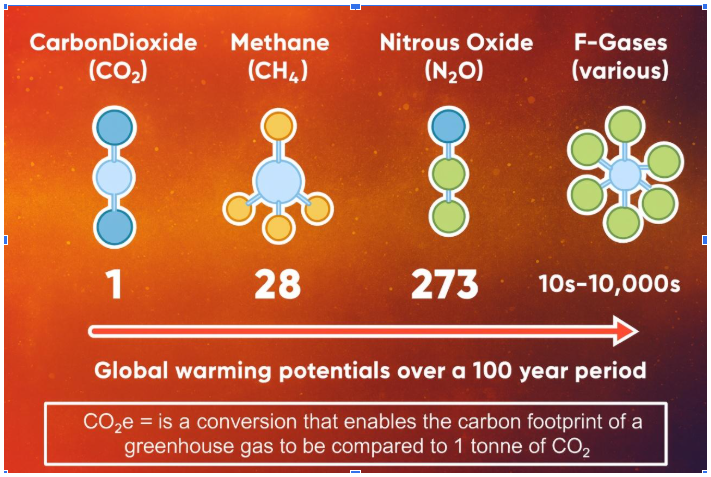
These are the four main greenhouse gases, which all trap heat to different degrees and remain in the atmosphere for varying amounts of time:
carbon dioxide (CO2),
methane (CH4),
nitrous oxide (N2O)
A group of fluorinated gases (F-gases)
CO2, CH4 and N2O are all natural gases; however, F-Gases are entirely man-made.
Some greenhouse gases are more effective at trapping heat in the atmosphere than others, and some remain in the atmosphere for longer. For example, methane lasts about a decade on average in the atmosphere, whereas CO2 lasts much longer in the atmosphere.
Global warming potential (GWP) value measures how effective a greenhouse gas is at trapping heat and the length of time it remains in the atmosphere, relative to carbon dioxide. Greenhouse gases which have a higher GWP value are more potent.
Over a 100-year period:
Methane has a GWP of around 28, meaning 1 tonne of methane warms the atmosphere by the same amount as 28 tonnes of CO2.
1 tonne of nitrous oxide warms the atmosphere by the same amount as 273 tonnes of CO2.
Fluorinated gases (F-gases) have a warming effect equal to that of 10-10,000 tonnes of CO2.
Even though carbon dioxide has the smallest GWP it is the greatest contributor to global warming due to the sheer quantity emitted. Human activities, such as irrigation, power-plant cooling and flying, contribute to water vapour in the atmosphere. However, humans are not responsible for emitting enough water vapour to significantly change its concentration in the atmosphere.
The main thing for us to take away here is how potent, how permanent, and how prevalent. How potent is the gas, how long is it likely to hang around in the atmosphere, and how much of that gas is there?
For any quantity and type of greenhouse gas, it expresses its impact in terms of the amount of CO2 that would result in the same amount of warming. i.e., 2 tonnes of CO2e = the same warming as 2 tonnes of carbon dioxide.
Before we move on, have you ever heard of CO2e?
Carbon dioxide equivalent (CO2e) allows the warming impact of different quantities of different greenhouse gases to be expressed as a single number.
This makes it a little easier for us to talk about greenhouse gases without getting all confused about which gases, where gases, and who gases.